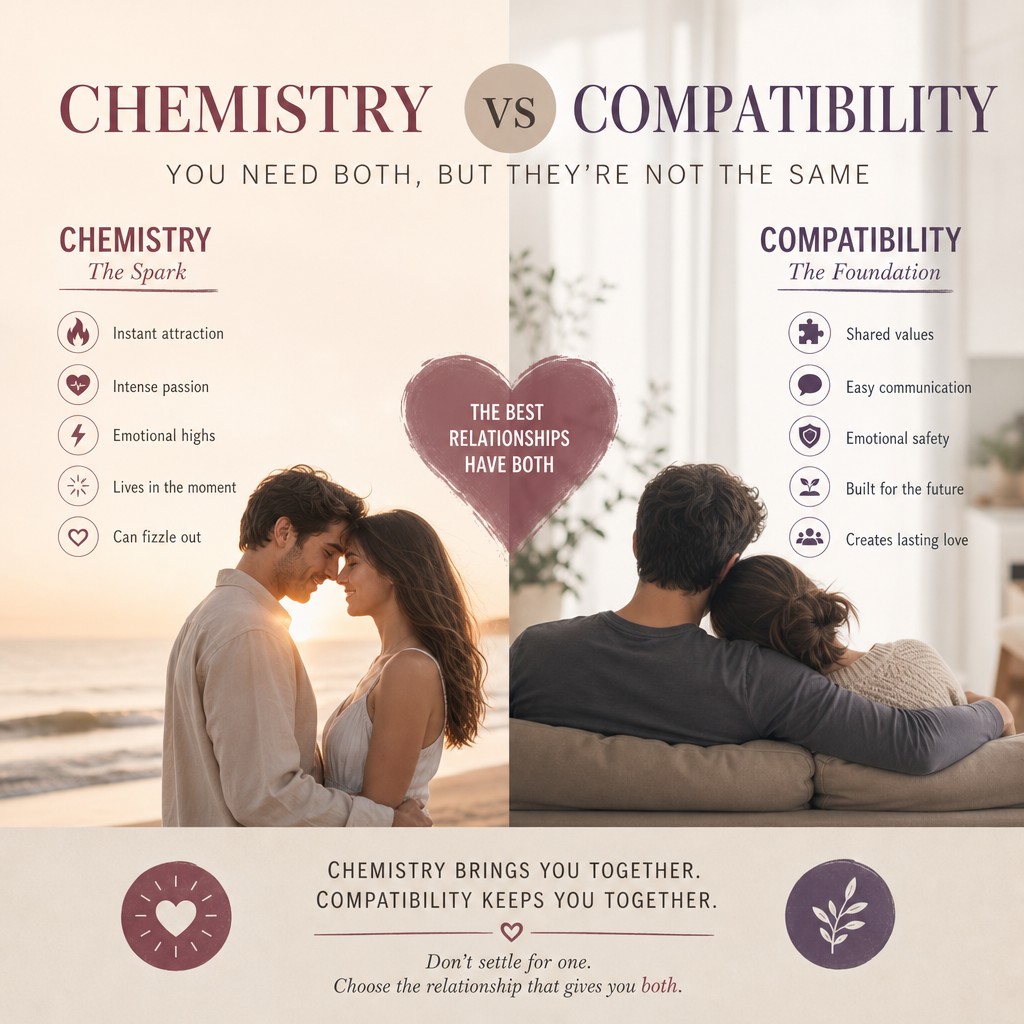
When sparks fly, it’s easy to believe you’ve found “the one.” Yet many people discover that passion alone doesn’t sustain a relationship. In fact, it can cloud your judgment regarding who is really right for you. Understanding chemistry vs. compatibility can help you to avoid chasing intensity and to instead seek healthier relationships where intimacy is more possible. Chemistry can light a spark, but compatibility keeps a relationship steady.
Today, we discuss how to recognize chemistry vs. compatibility, why people often confuse the two, and how that confusion undermines intimacy. We also provide guidance to help you prioritize compatibility without losing the joy of attraction. You’ll learn how to recognize emotional alignment, value consistency over adrenaline, and choose partners who bring both connection and calm, which is the true foundation of lasting love.

Chemistry vs. Compatibility: Two Kinds of Connection
Chemistry can feel electric: the rush of attraction, the spark that makes your heart race. A glance, a laugh, or a shared moment can create a powerful sense of connection that feels immediate and true. That experience is real and meaningful.
Scientists and therapists describe chemistry as a biological and psychological response that includes novelty, hormonal activation, and reward circuitry in the brain.
But that intensity can sometimes mask deeper incompatibilities. Many mistake emotional excitement for emotional safety, only to find themselves in relationships that burn bright and fade fast.
The truth is, chemistry draws you in, while compatibility enables a relationship to stand the test of time. When you learn to look for both, it helps you choose partners who not only ignite passion but also nurture trust, communication, and long‑term harmony.
What Does Chemistry Feel Like?
Relationship chemistry is the immediate, often intense reaction that draws you toward someone: the pull you feel before you know whether the relationship is actually healthy or sustainable. It’s emotional, physical, and neurological activation happening all at once, creating a sense of excitement, possibility, and connection that feels almost magnetic.
Researchers describe this reaction as a mix of hormones and brain reward signals that make being with that person feel exciting. Chemistry can be a signal that two people might enjoy each other’s company, but it does not provide reliable information about long term fit.
Some people find that chemistry can feel like destiny. That sense is powerful because it taps into deep motivational systems. When chemistry is strong, it can narrow attention and make you overlook practical mismatches. That narrowing explains why early infatuation sometimes blinds people to differences in values, communication style, or life goals.
Chemistry can be misleading. It may cause you to ignore red flags, feel false certainty, and pull you towards emotionally unavailable partners.
What Does Compatibility Look Like?
Relationship compatibility is the degree to which two people’s values, goals, habits, emotional needs, communication styles, and long‑term visions align. It shows up in how partners manage money, resolve conflict, and support each other during setbacks. Compatibility is less dramatic than chemistry. It reveals itself over time through consistent behavior and shared priorities.
Clinical and popular sources emphasize that compatibility sustains relationships through everyday demands and long-term change. When we are compatible with another, the relationship feels steady, supportive, and sustainable.
When compatibility is present, partners feel emotionally safe and able to be themselves. Conversations about difficult topics remain productive. Daily routines fit together without constant friction. Those practical patterns are the foundation that allows attraction to flourish rather than burn out.
Compatibility is the practical foundation of a healthy partnership. It shows up in how two people handle conflict, express affection, make decisions, and support each other’s growth. When compatibility is strong, the relationship feels calm, predictable, and emotionally safe. When it’s weak, even strong chemistry can’t compensate; the relationship becomes confusing, draining, or unstable.
Chemistry creates attraction. Compatibility creates partnership. You feel emotionally safe, respected, and understood when compatibility is present. You are able to be yourself and you are confident in the relationship’s direction. When compatibility is missing, you may feel anxious, confused, unseen, and like you are having to work too hard to keep the peace.
Why We Confuse Chemistry vs. Compatibility
Several forces may make chemistry feel like compatibility:
- Familiarity can masquerade as fit. Early attachment patterns shape what feels comfortable, so dynamics that mirror childhood relationships can register as chemistry even when they are unhealthy.
- Cultural narratives about love amplify the meaning of sparks. Stories in movies and music teach us to treat intensity as proof of truth, which biases early dating decisions.
- Emotional needs such as low self-esteem or fear of abandonment can push people toward partners who temporarily soothe insecurity, creating a false sense of match. Research and expert commentary point to these psychological and cultural drivers as common reasons for confusion.
The result is predictable. People rush into relationships based on excitement and then discover that the foundations are weak. Over time the mismatch shows up as repeated conflict, unmet needs, and a sense that something essential is missing.
The Real Differences: Chemistry vs. Compatibility
Chemistry pulls you in; compatibility holds you steady. Chemistry provides the spark, the rush of excitement, the butterflies, the sense that someone lights up your whole nervous system. It feels powerful because it is powerful. But chemistry alone can’t build a healthy relationship.
Compatibility is the quiet, consistent alignment that makes love feel safe, supportive, and sustainable. It’s the ease of communicating, the shared values, the emotional availability, and the mutual respect that allows intimacy to deepen over time.
When chemistry is high but compatibility is low, relationships feel thrilling but unstable. When compatibility is strong but chemistry is missing, relationships feel flat or disconnected. The healthiest partnerships blend both: the spark that draws you together and the stability that keeps you growing in the same direction.
The Impact of Confusing Chemistry vs. Compatibility
Emotional intimacy depends on two capacities: the willingness to be seen and to do so without collapsing into shame or withdrawal.
When willingness to be seen is high but the ability to be seen is untested, chemistry may dominate decision making. That imbalance leads to cycles of intense closeness followed by distance. Partners may mistake volatility for passion and then feel betrayed when steadiness is absent.
Long term studies and clinical observations show that relationships built primarily on chemistry are more likely to experience instability. Compatibility predicts satisfaction and resilience because it supports mutual responsiveness and practical cooperation.
Why We Choose Chemistry vs. Compatibility
Most people don’t choose chemistry vs. compatibility on purpose.
It happens because chemistry feels louder, faster, and more convincing. The nervous system interprets intensity as importance, so when someone sparks excitement, attraction, or familiarity, it creates a powerful pull that can overshadow logic and long‑term needs.
Chemistry activates dopamine, adrenaline, and old attachment patterns, making the connection feel meaningful even when it isn’t healthy.
Familiarity Bias in Relationship Patterns
Familiarity bias pulls us toward what feels known, even when those familiar patterns were never healthy. The nervous system prefers the predictable over the unfamiliar, so when someone grows up with inconsistency, emotional distance, or the need to walk on eggshells, their body learns to treat those dynamics as normal. As adults, they may gravitate toward the same patterns, not because they’re good, but because the nervous system recognizes them and interprets that recognition as comfort.
This is why a partner who is emotionally unavailable, unpredictable, or hard to read can create a stronger “spark” than someone who is steady and genuinely available. The body interprets old emotional rhythms as chemistry, not realizing it’s simply recognizing a pattern it has lived before.
Familiarity bias can lead us to make poor relationship choices:
- If highs and lows mirror our early emotional experiences, we may be attracted to inconsistency.
- We may mistake anxiety for desire because our nervous system may confuse activation with connection.
- We may be inclined to choose what feels “normal”; even painful dynamics can feel safer than unfamiliar stability.
- It can lead us to repeat unresolved patterns as the psyche tries to “fix” old wounds by reenacting them with new partners.
- We may also avoid true vulnerability. Familiar dysfunction feels easier than the risk of real intimacy.
Once you recognize familiarity bias, you can break the cycle by retraining your nervous system to feel drawn to what is healthy, not just what is familiar. That shift from old wiring to conscious choice is where real relationship transformation begins.
Chemistry vs. Compatibility: Attachment Activation
Attachment activation is one of the most powerful and misunderstood forces behind intense chemistry.
When someone’s behavior mirrors the emotional patterns you experienced earlier in life, your attachment system lights up. This activation can feel like attraction, longing, or even destiny, but it’s actually your nervous system responding to something familiar.
If you grew up around inconsistency, emotional distance, or unpredictability, partners who behave similarly can trigger a deep internal response that feels like chemistry. The pull isn’t about who they are; it’s about what your attachment system recognizes.
How Attachment Activation Creates “Chemistry”
What often feels like powerful chemistry is actually your attachment system working overtime. When someone is inconsistent or sends mixed signals, your attachment system activates more intensely, pulling you toward them in a way that feels compelling.
This dynamic often shows up in pursuit‑withdrawal cycles, where the chase becomes intoxicating because it mirrors early relational patterns. The ache of wanting someone quickly turns into a feeling of connection, and partners who are hard to read trigger old fears of abandonment, which makes the relationship feel deeper or more meaningful than it truly is.
In many cases, the psyche is drawn to people who behave in ways that resemble past wounds. This is often an unconscious attempt to resolve unfinished emotional business by recreating familiar dynamics.
Attachment activation isn’t subtle; it’s a full‑body experience. It can generate obsessive thinking, heightened desire, and anxiety that masquerades as passion. It often creates a sense of urgency and the belief that “this must mean something,” even when the connection is built on emotional unpredictability rather than genuine compatibility.
When you understand these patterns, you can begin to see that the intensity isn’t proof of connection. It’s a nervous system response to old, unhealed patterns.
Chemistry vs. Compatibility: Dopamine Reward Loops
Dopamine is the brain’s reward chemical. It’s the neurotransmitter that fuels desire, anticipation, and the thrill of possibility. When someone gives you attention, flirts, or creates emotional intensity, your brain releases dopamine, creating a pleasurable rush.
But here’s the catch: dopamine spikes not from consistency, but from unpredictability. This means that emotionally unavailable or inconsistent partners can trigger stronger dopamine loops than steady, reliable ones.
The brain becomes hooked on the “maybe,” chasing the next hit of validation, excitement, or closeness. What feels like chemistry is often a neurochemical cycle, not a sign of compatibility.
Chemistry vs. Compatibility: How Dopamine Reinforces Unhealthy Attraction
Dopamine plays a powerful role in reinforcing unhealthy attraction, especially when the connection is unpredictable.
Intermittent reinforcement, such as inconsistent bursts of affection, create the strongest dopamine spikes, making the relationship feel addictive. The brain becomes even more activated during the chase, because pursuing someone who is hard to get stimulates the reward system more than receiving steady, reliable care.
Small moments of attention become validation hits that feel disproportionately meaningful because they relieve the tension of waiting.
Dopamine also fuels fantasy amplification, causing you to idealize the person rather than see them clearly. And when the dopamine drops, withdrawal and craving set in. The anxiety or emptiness you feel pulls you right back toward the person for relief.
These dopamine loops don’t just create desire; they create compulsion. They can make you think about someone constantly, feel anxious when they pull away, interpret small gestures as big signs, confuse intensity with intimacy, and stay in relationships that don’t meet your needs.
This is why chemistry can feel irresistible even when the relationship is misaligned. It’s biology responding to unpredictability and emotional tension.
Chemistry vs. Compatibility: Cultural Messages
From childhood, we’re taught that love is supposed to feel instant, dramatic, and overwhelming. Movies, novels, and even music romanticize the idea that the strongest relationships begin with a lightning‑bolt moment; the kind of chemistry that sweeps you off your feet and erases all doubt.
These cultural messages shape our expectations long before we ever seek a partner. They teach us to equate intensity with destiny, passion with compatibility, and butterflies with emotional truth. So when we meet someone who triggers that familiar rush, it feels like confirmation that this must be “the one,” even if the relationship itself is unstable or misaligned.
Chemistry vs. Compatibility: How Culture Distorts Our Understanding of Love
Culture profoundly shapes how people interpret love, often in ways that create confusion and unrealistic expectations.
The soulmate myth teaches us that one perfect person will create instant, effortless connection, while movies and stories portray romantic drama such as conflict, jealousy, and chaos as proof of passion.
We’re taught to value intensity over stability, seeing the spark as the ultimate marker of compatibility, even though real partnership requires steadiness and effort. Narratives about love at first sight make slow‑building connection seem less meaningful, and the “shouldn’t have to try” myth undermines the reality that healthy relationships rely on communication and emotional maturity.
These cultural messages create a powerful bias: if a relationship doesn’t begin with fireworks, people assume something is wrong. They overlook emotionally available, compatible partners because the connection feels calm instead of chaotic, and they stay attached to unhealthy relationships because the intensity mirrors the love stories they grew up watching.
But the relationships that last often begin with steadiness, curiosity, and emotional safety; not a cinematic spark.
Fear of Vulnerability in Compatibility
Compatibility requires something many people aren’t taught how to do: let themselves be seen. For someone who has learned to protect themselves by staying guarded, hyper‑independent, or attuned to others’ needs instead of their own, true compatibility can feel threatening.
A partner who is steady, kind, and emotionally present creates opportunities for closeness, and closeness requires vulnerability. That vulnerability can trigger fear: fear of being known, of being disappointed, of losing oneself, or fear of repeating old wounds. So instead of choosing the partner who feels safe, many people choose the one who feels exciting, because excitement doesn’t require openness.
How Fear of Vulnerability Shows Up
Fear of vulnerability often shapes how people navigate chemistry vs. compatibility, even when they don’t realize it. Many people choose intensity over intimacy because intensity feels safer than slowing down and being emotionally exposed. Emotionally available partners (the ones who offer genuine compatibility) can feel unfamiliar or even “boring,” not because the connection is lacking, but because availability doesn’t activate old protective patterns.
Chemistry‑driven relationships keep someone in control and create distance, while compatibility asks both partners to influence each other and stay open to being shaped by the relationship. For someone who fears being truly known, desire feels safer than visibility, so being desired becomes easier to tolerate than being seen. And when chaos was the norm, calm can feel uncomfortable, leading to confusing emotional regulation with lack of connection.
Fear of vulnerability doesn’t equal being incapable of healthy love. It means their nervous system has learned to equate closeness with danger.
Understanding this fear is essential to shifting the balance in the chemistry vs. compatibility equation. When vulnerability becomes tolerable, emotionally safe partners stop feeling “too calm,” and compatibility becomes something the nervous system can recognize and receive. This is the turning point where relationships move from intensity and self‑protection to steadiness, connection, and genuine intimacy.
How to Recognize Compatibility
Compatibility is quieter. It shows up as steadiness, emotional safety, and alignment, all qualities that don’t create the same immediate rush.
For those who grew up around inconsistency or emotional unpredictability, the “spark” feels like home, while calmness feels unfamiliar or even boring.
Choosing compatibility doesn’t mean you must give up on passion. It means choosing a partner who can meet you emotionally, not just excite you temporarily. When chemistry and compatibility coexist, the relationship feels both alive and safe: the spark is there, but so is the stability.
Chemistry vs. Compatibility: Strategies to Help You Find Compatible Partners
Slow the pace. Allow time to see how someone behaves across contexts. Consistency requires follow through.
Define values based non negotiables. Choose three qualities that matter most to you, such as emotional availability, financial responsibility, or respectful communication. Use those criteria as filters for prospective partners.
Observe follow through. Do they keep small promises? Actions reveal priorities more than words.
Pay attention to your body. Calm and ease often indicate fit. If you feel chronically on edge, that is information, not a character flaw.
Ask practical questions early. Talk about routines, conflict styles, and future goals. Watch how answers translate into behavior.
Practice receiving. Experiment with accepting care and notice how it lands. Healthy reciprocity is a compatibility marker.
How to Address Unhealthy Attachment Patterns
If you repeatedly choose intensity over steadiness, explore whether old attachment patterns or low self-esteem are influencing your choices. Therapy or coaching can help you identify those drivers. Evidence based approaches that focus on awareness and behavioral experiments are effective for shifting attraction patterns.
Treat the early months in a relationship as a research period. Look for patterns rather than isolated moments. Does the person show up when life gets inconvenient? Do they communicate clearly about boundaries and needs? How do they handle conflict and disappointment? These observations are the most reliable predictors of whether chemistry will translate into a sustainable partnership.
When to Seek Support
If you find yourself repeatedly drawn to high drama or to partners who are inconsistent, professional support can accelerate change. A therapist or coach can help you process early wounds, practice boundary setting, and run behavioral experiments that test new ways of choosing. These corrective experiences help your nervous system learn that calm can be safe and that steadiness is desirable.
Chemistry vs. Compatibility: How to Choose Wisely
Sparks can start a story. Compatibility determines whether that story can become a life. Learning the difference between chemistry vs compatibility gives you the tools to enjoy attraction while also building relationships that endure.
When you slow down, observe behavior, and prioritize shared values, you increase the chance that your next relationship will feel both exciting and sustainable.
Thank you as always for reading.
Affiliate Disclosure: Some links in this post are affiliate links. As an Amazon Associate, we earn from qualifying purchases. Thank you for supporting Kindness-Compassion-and-Coaching.com at no extra cost to you.
No Responses