

Seasonal Affective Disorder (SAD) can have devastating impact on our mental health.
It may start to creep up on us in September. By mid-October it’s in full swing. By the time we get to February, we’re pulling our hair out, and it becomes the longest month even though it only has 28 or 29 days.
For many, there’s much more to it than a down mood. Some experience intense fatigue and tiredness, so daunting that no amount of sleep seems to rectify it. Aches and pains, all over. Irritability, too. It’s like the worst flu you’ve ever had, but this doesn’t stop when a fever breaks.
Read on to learn what seasonal affective disorder is and how to avoid and overcome it.
If you’re unsure if you have seasonal affective disorder, take our 10-question quiz to find out. Also, be sure to take a look at the items we recommend you include in your Fall SAD Toolkit (we’ve even reviewed light therapy lamps and provided tips on how to choose one that’s best for you).
And last, but not least, don’t forget to grab your free printable, too.
If you are feeling tired every day, you may also wish to visit Beyond Burnout: How to Overcome Chronic Fatigue and More.
Table of Contents
- All About Seasonal Affective Disorder (SAD)
- Seasonal Affective Disorder: When Will We Snap Out of It?
- Why Fall Feels Different: The Biology of Fall SAD Symptoms
- Seasonal Affective Disorder: The Factors That Make Us Feel SAD Right Now
- Frequently Asked Questions about Seasonal Affective Disorder (SAD)
- 10 Ways to Avoid Seasonal Affective Disorder
- Get outside to overcome seasonal affective disorder.
- Get light other ways.
- Move more to overcome seasonal affective disorder.
- Eat healthy to avoid and overcome seasonal affective disorder.
- Make commitments that matter.
- Scratch a few things off the to-do list to avoid and overcome seasonal affective disorder.
- Ask for or accept help to avoid or overcome seasonal affective disorder.
- Consider vitamins.
- Remember what keeps you grounded.
- Tend to your own personal grooming to overcome seasonal affective disorder.
- Light Therapy
- Additional Tools for Relief from Seasonal Affective Disorder
- Additional Resources and Wrap Up

All About Seasonal Affective Disorder (SAD)
It’s debilitating and impacts every aspect of our lives. Luckily, there are ways to avoid it or stop it in its tracks. Before we get into that, let’s talk about some of the other symptoms we may feel this fall. You may already be nodding your head in agreement, but there’s more. We all know it’s coming.
Beyond the fatigue and sadness:
- Perhaps we’re not being as patient as we normally are.
- Our energy levels are low, and this contributes to our lethargy.
- We’re disappointed in ourselves, for a host of reasons: we didn’t get our chores done; our body isn’t the size or shape we want; at night, especially, we can’t seem to get off the sofa; we feel like we’re letting friends and family down.
- And the guilt makes it worse.
At a certain point we become frightened enough to wonder – will I ever feel joy or happiness again? Or will I feel sad forever?
Seasonal Affective Disorder: When Will We Snap Out of It?
That’s when it may help to know there are specific things that cause us to feel so especially crummy this time of year. Right now, there are many things going on around us that contribute to a general sense of malaise. And for those who suffer with mental illness, it can be enough to set off a serious depressive episode.
Knowing the natural triggers we’re all dealing with right now; and to know that at least some of this shall pass, may be helpful, for some. But information is always useful – so here’s some more.

Why Fall Feels Different: The Biology of Fall SAD Symptoms
As daylight hours shrink and temperatures dip, many people notice a shift in their mood, and these are the hallmark signs of fall SAD symptoms. Cooler weather and fading sunlight disrupt your body’s natural circadian rhythm, making it harder to regulate sleep-wake cycles and maintain steady energy levels.
When your internal clock senses less morning light, it triggers an increase in melatonin (the sleep hormone) and a drop in serotonin (the mood-boosting neurotransmitter). This chemical imbalance can manifest as lethargy, irritability, and a craving for carbohydrates, core features of fall SAD symptoms.
Beyond physiology, autumn brings environmental and emotional triggers. Fallen leaves and overcast skies can feel visually muted, feeding a sense of melancholy. Routine changes, like earlier evenings and indoor confinement, limit social connection and movement, which are key buffers against seasonal low mood.
Seasonal Affective Disorder: The Factors That Make Us Feel SAD Right Now
Sometimes it helps to understand more details about the actual drivers of our mental, physical and emotional experience, beyond the biological facts. Some of the key factors that make this time of year especially challenging include:
The days are shorter and colder.
Basically, less sun = less happiness. For a number of reasons. When there’s less sun, we spend less time outdoors and active. We spend more time indoors, sitting still, and also very often, alone. There’s also the Vitamin D thing; sun helps us meet our needs in this area. To make matters worse, more darkness makes us produce more melatonin, a hormone that makes us sleepy; and since it’s getting dark earlier in the day, we’re getting dosed with melatonin earlier, and feeling sleepy earlier, too.
So, we’re not only indoors, sitting still, alone, but our bodies are making us tired. All because of the change of seasons. It’s not our fault!
Stressful decisions.
Yes, that joyful time of year is not always so joyful. The emotional decisions:
- Do we visit my family or his?
- Do we make the kids stay home with family or do we let them visit with their friends?
- How will we balance their schedules with ours?
- How shall we travel? Or will the relatives visit us?
- How can we make sure everyone feels loved and no one is left out?
Family is a blessing, but all the juggling of our obligations can also raise our stress levels. Layer that on top of end of the year deadlines for work, and/or loneliness – which tends to strike some of us worst this time of year – and it’s a recipe for volatile emotional swings, which can be exhausting.
Other sources of stress.
This time of year, there are too many to count.
- Gift-choosing, finding, and wrapping.
- Extra shopping and baking.
- Meal planning, ingredient shopping, food preparation, extra household chores, incoming guests, and/or travel arrangements to make, just to name a few.
- The long list of “shoulds” that begins to overcome our joy.
- I should go visit Aunt Marie. I should make homemade treats. If I don’t spend time with Mom or Dad, I’m not a good daughter.
- Can’t forget my partner’s Mom and Dad, and oh the stepparents, too.
- I forgot to buy gifts for the teachers.
We begin to feel we are not enough because our list of the requirements to be enough is too darn long.
We’re eating a lot of stuff that doesn’t help.
It’s cold outside, and all we want is a nice warm, hearty meal. Enter the food that’s loaded with carbs and fat, some of which we would never even think of consuming on a hot summer day. It’s our body’s natural survival instinct – chow down to survive the winter. Except now we have coats and heat and fireplaces and other things to help us survive – we don’t need to eat a Woolly Mammoth!
And after a heavy main course, maybe with a cocktail or two, the dessert becomes harder to resist too. We want, no, we NEED some sugar to balance out all that fat – and what’s one or two cookies, or a piece of pie, a glass of eggnog in the grand scheme of things? I find myself eating things in November that I would never even be tempted by in July. Is there anyone out there who drinks eggnog or Irish coffee in July?
What we need to do is put into our body things that will make us feel healthy and good, and that can be difficult to achieve.
We’re not touching Mother Earth.
Remember that post about grounding? Coming in touch with the earth, whether it be from walking barefoot, gardening, or some other outdoor activity, provides us with a natural boost. The scientific explanation has to do with the free radicals in our bodies. “Grounding” is another way to get some of those wonderful antioxidants we read so much about. And needless to say, when it’s dark and cold outside – we get less of this natural boost.
Vacation is a distant memory.
For many, it’s been a darn long time since that once-a-year summer vacation. Burn-out is rearing its ugly head at the time of year when we’re trying to dig deep for that extra boost of energy we need to take on some tasks that can seem almost insurmountable.
I could keep going, but you get the idea — there’s a whole lot going on that’s making us feel our worst. Maybe the key message here is: Know that it’s not just you! And it’s natural — for most of us this time of year, we just fall into a bit of a slump.
For some, it’s a mild case of sadness, or the “blahs” and reading a post or two like this may give us some ideas about how to try and get some spring back in our step. But for others, it is much more serious. Seasonal affective disorder (SAD) is a form of clinical depression.
If you feel as though you are suffering from this and are unable to find relief, please seek care from professional mental health providers right away.
Frequently Asked Questions about Seasonal Affective Disorder (SAD)
What is seasonal affective disorder (SAD)?
Seasonal affective disorder is a type of depression that follows a seasonal pattern, most commonly emerging in the fall and winter months when daylight hours shrink. Symptoms include persistent low mood, fatigue, irritability, changes in sleep or appetite, and difficulty finding joy in usual activities. SAD can range from mild “winter blues” to a more severe, clinical depression that impacts daily life.
How do I know if I’m experiencing SAD or just the winter blues?
The winter blues are common and generally milder, featuring brief dips in mood that lift on sunnier days. SAD involves more intense symptoms that persist for weeks or months, interfere with work or relationships, and often recur at the same time each year. If your low mood is accompanied by significant fatigue, changes in sleep or appetite, or a sense of hopelessness, it’s likely more than a temporary slump.
When should I seek professional help for SAD?
If your symptoms last longer than two weeks, worsen despite self-care efforts, or you experience thoughts of self-harm, reach out to a mental health professional immediately. Early intervention—through therapy, medication, or a combination—can prevent a full depressive episode and help you resume your normal routine more quickly.
Are light therapy boxes effective for treating SAD?
Light therapy boxes are one of the most studied and widely recommended treatments for SAD. Sitting 16 to 24 inches from a 10,000-lux light box for 20 to 30 minutes each morning mimics natural sunlight, helping to regulate melatonin and serotonin levels. Many people notice mood and energy improvements within one to two weeks of consistent use.
What lifestyle changes can help manage SAD symptoms?
- Establish a daily routine for waking, sleeping, and meals to stabilize your body clock
- Spend at least 20 minutes outdoors during daylight, even on cloudy days
- Move your body through walking, dancing, or home workouts to boost circulation and endorphins
- Prioritize nutrient-rich meals with lean protein, whole grains, fruits, and vegetables
- Schedule weekly self-care activities such as a massage, journaling session, or video call with a friend for accountability and purpose
Can SAD occur during other seasons?
While winter-pattern SAD is most common, a less frequent form appears in spring or summer. Symptoms may include anxiety, insomnia, and weight loss instead of lethargy and increased appetite. If you notice seasonal mood shifts outside the typical pattern, track your symptoms and discuss them with a professional.
Are there any supplements that can help with SAD?
Vitamin D deficiencies often coincide with reduced sun exposure, so a daily supplement may support mood stabilization. B vitamins (especially B6 and B12) play key roles in neurotransmitter production. Always consult your healthcare provider before starting any new supplement to ensure safety and proper dosage.
How can I support a loved one struggling with SAD?
- Encourage them to try light therapy or join you for a daily walk.
- Listen without judgment when they describe their experience.
- Offer to help with practical tasks, like grocery shopping or cooking healthy meals.
- Celebrate small wins to reinforce progress.
- Remind them that professional help is a sign of strength, not weakness.
10 Ways to Avoid Seasonal Affective Disorder
For those who would like to give it a go, here are some ideas about how we can try to offset some of the natural conditions that are bringing us down – or even prevent them from happening at all!
Get outside to overcome seasonal affective disorder.
Especially when the sun is shining. Try for 20 minutes a day. I remember reading something like this once: Put on comfortable walking shoes. Tell yourself you will walk to the mailbox (and back). When you get to the mailbox, odds are, you’ll find the motivation to keep going. So just decide, I’m going to walk to the mailbox every day. Put do it prepared to continue.

Get light other ways.
If it’s bitter cold outside, just sitting by a window where there’s natural light can help. Better still, is to take advantage of light boxes available for home use – research consistently supports their use to ease seasonal affective disorder and depression symptoms. See our recommendations in Section 7.
Move more to overcome seasonal affective disorder.
Any way possible. Getting geared up for exercise is tough when we’re feeling down, so if that’s not feeling realistic right now, know that even just simple movement helps a lot.
- Take the stairs.
- Stand while you take a phone call.
- Walk around the house or your office.
- Crank up some tunes and dance it out!
Getting circulation going helps everything. If you can do it outside, it’s a double dose of goodness. Well, maybe not the dancing? Or who knows … perhaps you’ll make some new friends?
Eat healthy to avoid and overcome seasonal affective disorder.
Yes, I know – easier said than done, right? It can help to just commit to have a healthy breakfast. Find some easy breakfast foods that are convenient and good for you and keep them around. And we need to make ourselves drink at least 1 full glass of water with breakfast to partially re-hydrate to start the day. Being dehydrated can mess with us in many ways.

Make commitments that matter.
To yourself and to others. Put something on the calendar that you must show up for. It helps provide a sense of purpose. Double points if the thing you have to show up for is self-care of some kind! Try to schedule at least 1 thing a week for the rest of the year. Perhaps 1 week it’s a haircut. Another week, it’s a massage. Maybe 1 week we plan lunch with a friend. Just scheduling these things can help us feel productive.
Scratch a few things off the to-do list to avoid and overcome seasonal affective disorder.
One or two fewer gifts, one or two fewer dishes to cook, one or two “shoulds” that aren’t required or bringing you joy. In the end, taking care of our own needs is so much more important to everyone in our lives. If there are a handful of traditions that are important to your family, make them the priority. And let some of the rest slide.
Ask for or accept help to avoid or overcome seasonal affective disorder.
Many people enjoy helping others out, especially this time of year when they may be feeling more lonely than usual. Maybe Grandma or Grandpa would like to be more involved in the holiday prep this year? And the kids – they are a year older! What can they do to lighten your load? Give them a chance to show up for you and be proud of themselves, too.
Consider vitamins.
Some of us can really benefit from a supplement or two especially during this time of year. Vitamin B and D are both popular but check with your doctor to see what may work best for you.
Remember what keeps you grounded.
When we’re feeling down, seeking out experiences that bring short term happiness, like an epic party or wild night on the town can often have a boomerang effect. A short-term high can be followed by a worse low. So, think about what makes you content. Calm. Peaceful. Seek steadiness vs. giddiness.
For some, meditation or other mindfulness activity works. For others, it’s prayer or volunteering or doing puzzles or some other hobby like knitting or crocheting or even doing a crossword. Whatever your calm is, get more of that in your life. For more great ideas, visit this article, focused on Seasonal Mindfulness.

Tend to your own personal grooming to overcome seasonal affective disorder.
Sounds basic. But there are many days when this is a challenge for many of us! Get out of the clothes you slept in. Wash your face. Take a shower. Put on some makeup if you enjoy that. If things are really rough, break this down into small steps. Each step helps bring us out of the darkness a bit. And like flowers, we will all eventually feel the natural pull of the sun.
It can feel almost like we’re required to be “jolly” this time of year, or any time of year. But it’s definitely not that simple for many of us. So, let’s all try to be extra kind and supportive and understanding of one another. It feels much more manageable when we remember that we’re all in this together.
Light Therapy
Light therapy is a clinically proven intervention for Seasonal Affective Disorder, consistently showing significant reductions in low mood, fatigue, and sleep disturbances when used daily. By mimicking natural sunlight, these lamps help reset your circadian rhythm and lift your energy levels during the darker months. You will see our recommendations for light therapy lamps in Section 8, however, in the event you want to choose your own, we’re also sharing the considerations you should keep in mind as you shop.
How to Choose Your Perfect Light Therapy Lamp
Picking the right lamp maximizes your relief and ensures you actually use it every day. Focus on these core features:
- Light Intensity (Lux): Aim for a minimum of 10,000 lux at a comfortable distance (typically 12–18 inches). Anything less will require longer daily sessions.
- UV-Free Filter: Look for medical-grade lamps that block harmful UV rays, even if you’re only using it for 20–30 minutes, UV protection matters.
- Size & Portability: A compact desk lamp works if you’re stationary; a larger floor-standing model gives you more flexibility to move around your home.
- Adjustable Angle & Height: An articulating arm or pivoting head lets you customize the light direction, so you don’t have to hunch over your desk during use.
- Built-In Timer & Auto-Off: Having a timer means you can set it and forget it, no need to watch the clock while you sip your morning coffee.
- Certification & Warranty: Choose lamps certified by organizations like the FDA or CE and backed by at least a one-year warranty to safeguard your investment.
By comparing these features against your daily routine, budget, and workspace, you’ll land on a lamp that feels as natural to use as your morning mug of tea—only this time, it’s sunshine on demand.
Don’t forget to check out our Light Therapy Lamp Buyer’s Guide, including a Buyer’s Guide printable, and a seasonal affective disorder printable bundle!
Additional Tools for Relief from Seasonal Affective Disorder
Supplementing self-care with tools beyond light therapy will make a big difference.
See below for our recommended products to build your own SAD care kit.
| Product | Mini-Review |
|---|---|
| Verilux HappyLight Luxe* | Best light therapy lamp for seasonal affective disorder. Options for every budget. Get up to 10,000 lux of UV-free bright white light, 4 brightness levels, 3 color temperatures, programmable timer. Durable design. Best for home users seeking a versatile, high-output lamp. |
| Circadian Optics Lumos 2.0 Light Therapy Lamp | Compact “Shark Tank” favorite offering 10,000 lux and full-spectrum light in a slim, travel-ready form. Best for travelers and small-space dwellers. |
| The Sadness Book: A Journal to Let Go By Elias Baar | Blends structured prompts with free-write pages to help you name and release seasonal lows. Simple layout. Best for journaling fans and those who like self-guided healing. |
| Winter Blues: Everything You Need to Know to Beat Seasonal Affective Disorder | Renowned psychiatrist Norman E. Rosenthal deep dive into SAD’s science. Case studies and actionable strategies, from light therapy to diet tweaks. Best for readers seeking evidence-based guidance. |
| Bergamot Essential Oil (100% Pure, Therapeutic-Grade) | Bright, citrusy aroma shown to lower blood pressure and induce calm. Easily diffused or inhaled. Best for aromatherapy beginners. |
| Lavender Essential Oil (100% Pure, Therapeutic-Grade) | Calming floral scent with robust research supporting its anxiety-reducing and sleep-enhancing effects. Perfect for diffusing at bedtime. Best for anyone needing stress relief and better sleep. |
| Sweet Orange Essential Oil (100% Pure, Cold-Pressed) | Energizing, uplifting citrus aroma that combats lethargy and sparks creativity. Best for those with a morning routine to promote creative bursts. |
*Kindness-Compassion-and-Coaching.com favorite product to ease symptoms of Seasonal Affective Disorder (SAD).
Additional Resources and Wrap Up
You’ve explored evidence-backed strategies and seen how a light therapy lamp, guided workbooks, and essential oils can buffer the autumn and winter blues. Now it’s time to take the next step to broaden your learning and deepen your commitment to self-care.
Scroll back up to the recommended products table, choose the items that resonate with you, and click through to complete your purchase. Every resource you add to your arsenal transforms knowledge into daily action.
Each purchase you make not only equips you for the darker months ahead but also fuels our mission to deliver trauma-informed, compassionate guidance, at no extra cost to you. Thank you for supporting our work and for investing in your own resilience.
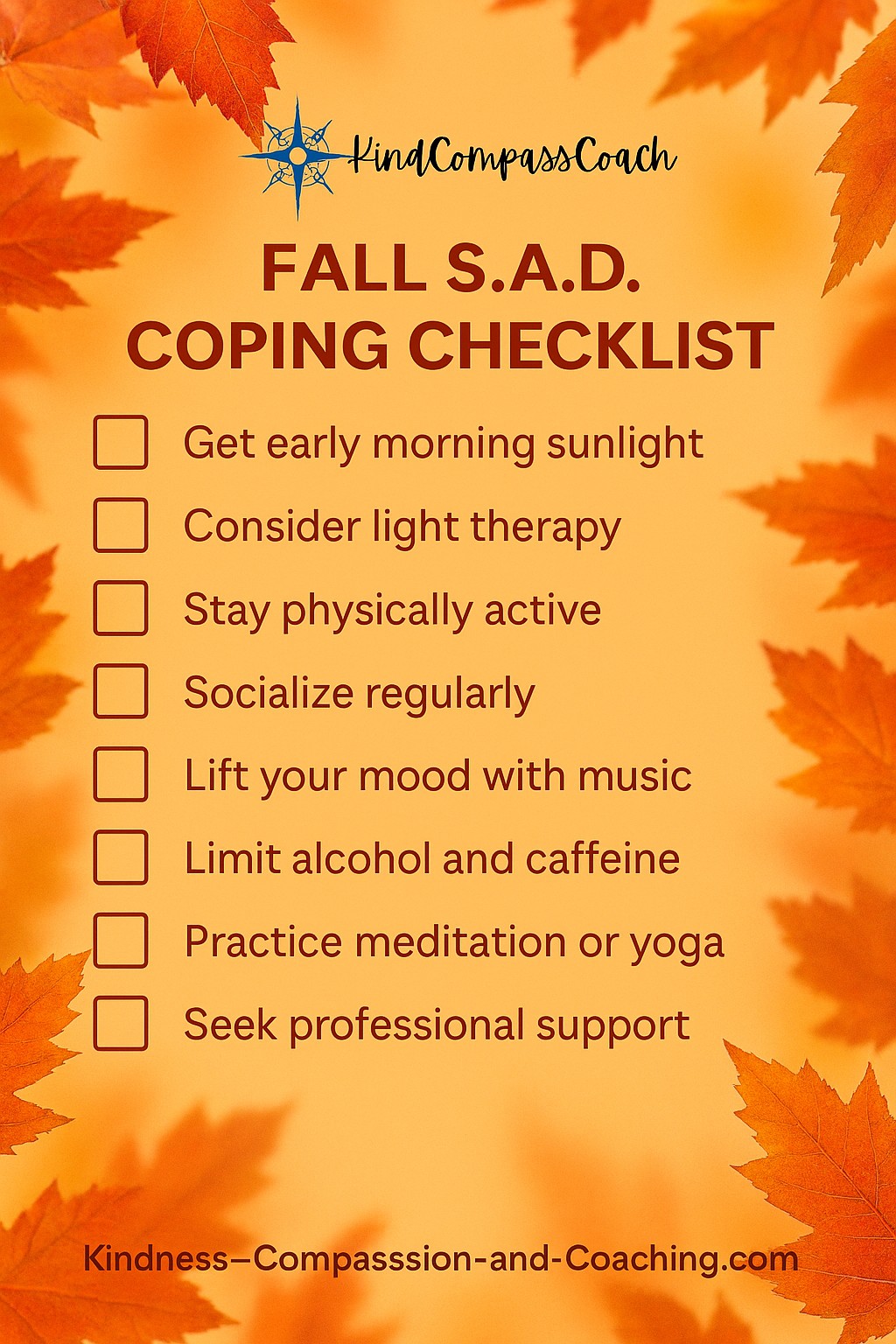
To deepen your self-care practice alongside these tools, download your own copy of our free printable:

To further deepen your collection of tools and your knowledge, also read our companion articles, including:
- How to Experience Emotional Self-Care Like Never Before
Discover simple yet powerful rituals that turn everyday moments into opportunities for emotional nourishment. - 100+ Self-Care Journal Prompts: How to Find Self-Love Now
Harness the power of writing to cultivate gratitude, process tough emotions, and reinforce a kinder inner dialogue. - The Best Weighted Blankets for Anxiety: How to Choose the Right One.
Thank you for investing in tools and for supporting our mission to deliver trauma-informed, compassionate guidance. Here’s to seasons filled with light, warmth, and wholehearted self-care!
Thank you as always for reading.
Affiliate Disclosure: Some links in this post are affiliate links. As an Amazon Associate, we earn from qualifying purchases. Thank you for supporting Kindness-Compassion-and-Coaching.com at no extra cost to you.

Joan Morabito Senio is the founder of Kindness-Compassion-and-Coaching.com. Joan’s career includes clinical healthcare plus 20+ years as an executive in a nationwide health care system and 15 years as a consultant. The common threads throughout Joan’s personal and professional life are a commitment to non-profit organizations, mental health, compassionate coaching, professional development and servant leadership. She is a certified Neuroscience Coach, member of the International Organization of Life Coaches, serves as a thought-leader for KuelLife.com and is also a regular contributor to PsychReg and Sixty and Me. You can read more about Joan here: Joan Senio.




No Responses